How Long Does EV Charger Installation Take? Full UK 2026 Timeline
The honest answer to “how long does an EV charger installation take?” has two parts. The on-site fitting itself is usually 3–4 hours. The end-to-end timeline — from your first enquiry to plugging in your car — is anywhere from a week to two months depending on grants, DNO notifications, factor permissions, and whether your consumer unit needs work.
This guide separates the two, walks through every stage in the order it actually happens, and flags the Scottish-specific bits (SP Energy Networks notification, factor consent for tenements, OZEV in Scotland) that catch people out.
Most standard EV charger installations across Glasgow and Central Scotland are completed within a single day, with only a few situations requiring additional work or approvals.
Infographic
How long does EV charger installation actually take?
A visual walkthrough of the typical install timeline across Glasgow and Central Scotland.
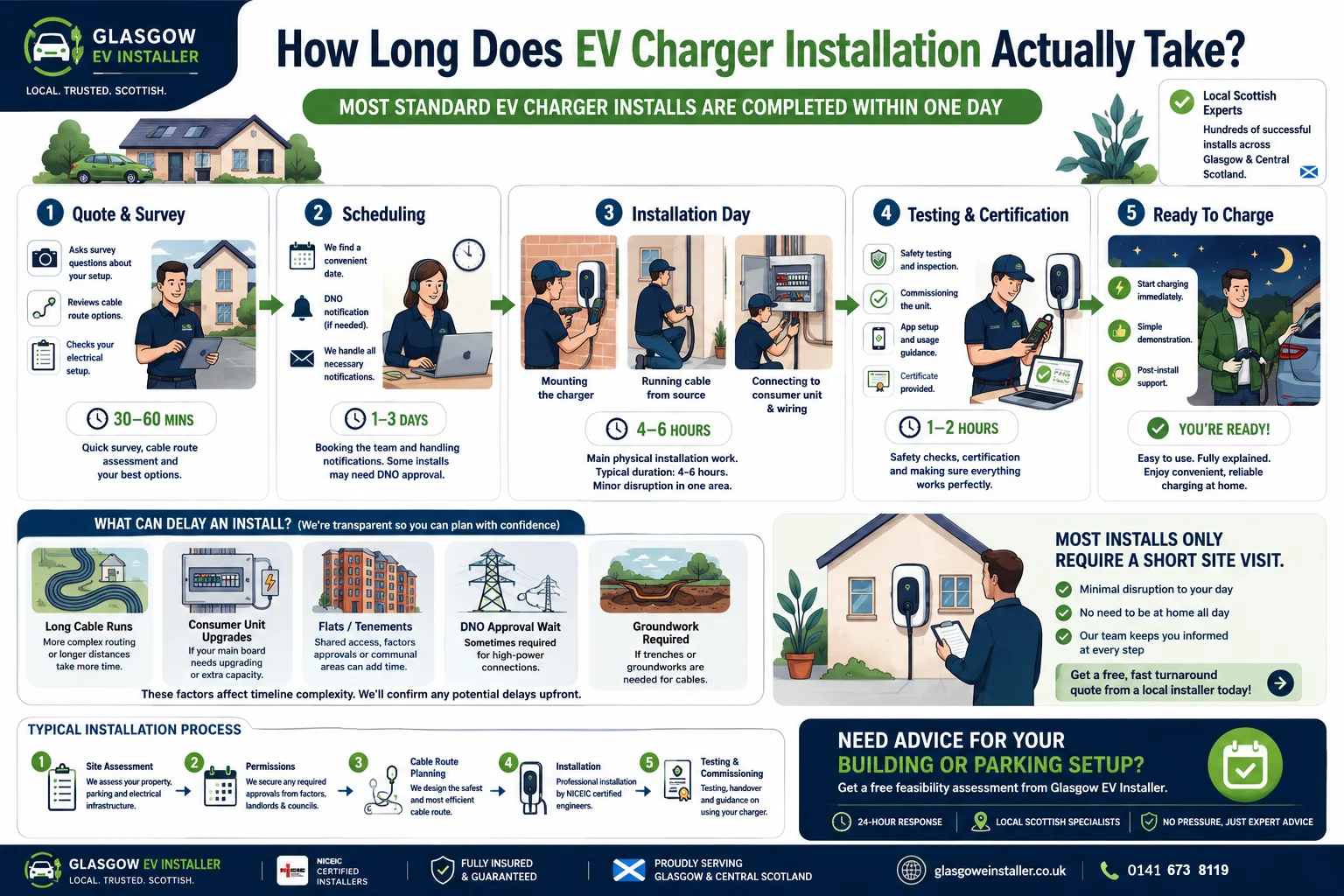
Based on standard home installations
Most standard EV charger installations only require a short site visit.
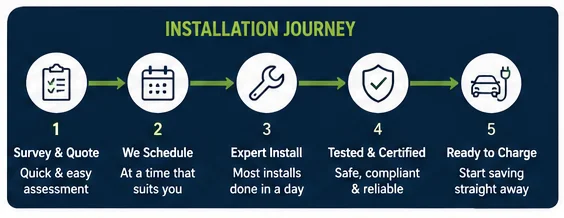
Most standard installations are completed within one day with minimal disruption to the property.
Ready to start your installation journey?
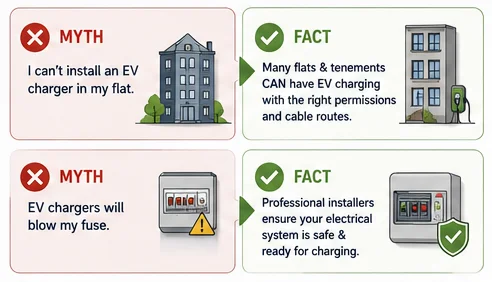
Professional EV charger installers assess your property, electrical capacity and permissions before recommending a safe installation approach.
Unsure whether your property can support EV charging?
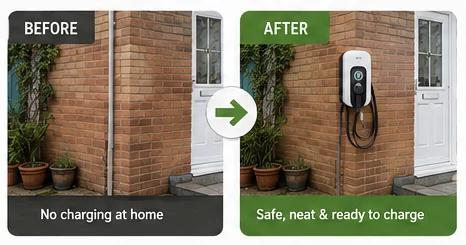
Most standard installations are completed within one day with minimal disruption.
Ready to install home EV charging?
From first enquiry to first charge — the full process
- 1Enquiry & photos sent
- 2Site survey (30–60 min)
- 3Fixed quote returned
- 4OZEV grant approval (if eligible)
- 5Installation day — on-site, 3–4 hours
- 6Testing, certification & app pairing
- 7DNO notification filed (within 28 days)
“Eighty percent of the wait is paperwork and scheduling. The electricians are on your wall for half a working day.”
End-to-end timeline at a glance
| Stage | What happens | Typical duration | Type |
|---|---|---|---|
| 1. Enquiry & photos | You send photos of meter, fuse box, parking, cable route | Same day | Admin |
| 2. Site survey | Installer visits or does a video survey | 30–60 min, booked within 2–5 days | Admin |
| 3. Fixed quote | Charger model, cable run, extras priced up | Within 24 hrs of survey | Admin |
| 4. DNO notification | Notification (not approval) for 7kW/32A in Scotland | Filed by installer; no wait for standard 7kW | Admin |
| 5. OZEV grant approval (if eligible) | Evidence pack → OZEV portal | 5–10 working days | Admin |
| 6. Scheduling | Diary slot booked | 1–10 days depending on installer load | Admin |
| 7. Installation day | Mount, run cable, wire CU, commission | 3–4 hours (standard) | On site |
| 8. Testing & certification | EICR-style test, BS 7671 cert, charger paired to app | 30–45 min, same day | On site |
| 9. DNO notification submitted | Within 28 days of energisation | Filed after install | Admin |
Admin time vs actual installation time
This is the single most useful distinction to understand. The electricians are on your wall for 3–4 hours. Everything else is paperwork and scheduling — and that's where the delays come from.
| Category | What it covers | Typical share of total wait |
|---|---|---|
| Admin / waiting | Survey booking, quote, grant, DNO, scheduling | ≈ 80–95% of total elapsed time |
| Actual installation work | Cable, mounting, wiring, commissioning, test | ≈ 5–20% of total elapsed time |
If your installer is well-organised and you respond to emails quickly, a standard Glasgow driveway install can be done in 7–10 days from first enquiry. If you're chasing OZEV grant evidence and factor consent, the same physical job can take 6–8 weeks to reach the point where an electrician turns up.
Stage 1 — Survey (30–60 minutes)
A good installer either visits in person or does a video survey. They'll check: main fuse rating (typically 60A, 80A or 100A in Scotland), consumer unit condition, earthing arrangement (TN-S, TN-C-S/PME, or TT — common in older Scottish properties), proposed cable route, and parking layout. Most surveys are booked within 2–5 working days of your enquiry.
Stage 2 — DNO notification (the bit most guides skip)
In Scotland, your DNO is SP Energy Networks (most of the central belt and south) or SSEN (Highlands, north-east). For a single 7kW (32A) home charger, only post-installation notification is required — there's no waiting period before fitting. The installer has 28 days after the install to file it.
Pre-approval (which can take 6–10 weeks) is only needed if you're combining the charger with battery storage, solar PV uplift, a second charger pushing the property above 32A total, or a 22kW three-phase install. Most homes don't need it.
Stage 3 — OZEV grant approval (5–10 working days, if eligible)
Eligibility is mainly flats and rental properties — see the OZEV grant Scotland 2026 guide for who qualifies. Once your installer submits your evidence (V5C or lease agreement, parking proof, landlord consent for rentals), authorisation is usually back inside two weeks. Don't book the fitting date until authorisation is in — claims can't be backdated.
Stage 4 — Scheduling (1–10 days)
Lead times depend on installer demand. Spring (March–May) and the run-up to Christmas are the busiest periods in central Scotland. Quiet weeks can mean a fitter on your wall in 24–48 hours; peak weeks can be 2–3 weeks out.
Stage 5 — Installation day, hour by hour
| Time | What's happening |
|---|---|
| 0:00 – 0:30 | Arrival, dust sheets down, isolate the supply, re-check the cable route |
| 0:30 – 1:30 | Run the cable — clipped externally, drilled through the wall, or in conduit |
| 1:30 – 2:30 | Mount the charger, terminate cable, fit dedicated MCB/RCBO in the consumer unit |
| 2:30 – 3:15 | Energise, commission via the manufacturer app, pair to Wi-Fi/4G |
| 3:15 – 3:45 | Insulation resistance, earth fault loop, RCD/Type-A+6mA test, fill in BS 7671 certificate |
| 3:45 – 4:00 | Walkthrough with you: app, scheduling, smart tariff setup, paperwork handed over |
Standard vs complex vs flat — realistic timings
| Scenario | On-site fitting time | End-to-end timeline |
|---|---|---|
| Standard driveway, modern CU, sub-10m cable run | 3–4 hours | 7–10 days |
| Older property needing CU upgrade or earth rod (TT) | 5–7 hours | 2–4 weeks |
| Long cable run (10–25m), conduit, drilled through stone | 5–8 hours, possibly 2 days | 2–4 weeks |
| Flat with allocated bay, factor-managed building | 5–7 hours on the day | 4–8 weeks (factor consent) |
| Tenement with shared close and communal supply | Survey may be 2 visits; install 6–8 hours | 6–10 weeks |
| Conservation area / listed building | 4–6 hours, restricted external work | 4–12 weeks (planning) |
Scottish factor & tenement reality check
Tenement and modern flat installs in Glasgow, Edinburgh, Paisley and Stirling are almost always rate-limited by factor consent, not by the electrician's calendar. James Gibb, Hacking & Paterson, Lomond and Ross & Liddell typically respond inside 2–4 weeks; some smaller factors take 6–8. Start the consent conversation before you book the survey — it runs in parallel with everything else.
For the full tenement playbook, read our Glasgow tenement EV charger guide.
Common causes of delay (and how to avoid them)
- Old consumer unit — wylex/MK fuse boxes from pre-2008 usually need replacing. Add 1–2 hours and ~£300–£450; flag it at survey, not install day.
- TT earthing (no PME / no TN-S) — common in rural Aberdeenshire, parts of Lanarkshire, older detached homes. Needs an earth rod; adds 1–2 hours.
- Missing OZEV evidence — landlord consent letters and lease scans are the #1 cause of grant delays. Get them ready before you apply.
- Wi-Fi blackspot at the parking bay — many smart chargers need connectivity. Ohme and Zappi ship with a SIM as standard; others need a mesh extender.
- Booking before grant approval — OZEV claims can't be backdated. Wait for the authorisation email.
- Stone walls in tenements — drilling through 600mm sandstone takes longer and may need core drilling. Add an hour.
Frequently asked questions
Can I get an EV charger installed next day?
Occasionally, yes — for a cash-paying customer with a modern consumer unit, no grant, and an installer with a free slot. Realistically, plan for a week.
Do I need to be home for the install?
Yes. The supply needs to be isolated, you need to sign off the certificate, and the installer will walk you through the app pairing.
Will my power be off all day?
No — typically only 30–60 minutes total while the consumer unit is opened up and the new circuit is added.
How long is the certificate valid?
The BS 7671 minor works / installation certificate doesn't expire, but a periodic EICR every 5–10 years is recommended for the rest of the property.
Get a realistic timeline for your property
Every Scottish home is a slightly different timeline. We connect Glasgow and central Scotland homeowners with NICEIC-approved installers who survey, file the OZEV claim and DNO notification for you, and book a fitting date — typically inside 7–14 days for a standard install.
Related questions
- →How long does a Scottish EV charger installation take end-to-end?
- →What is DNO approval and do I always need it?
- →Can the install be done in one day?
- →What certificates should I receive on completion?